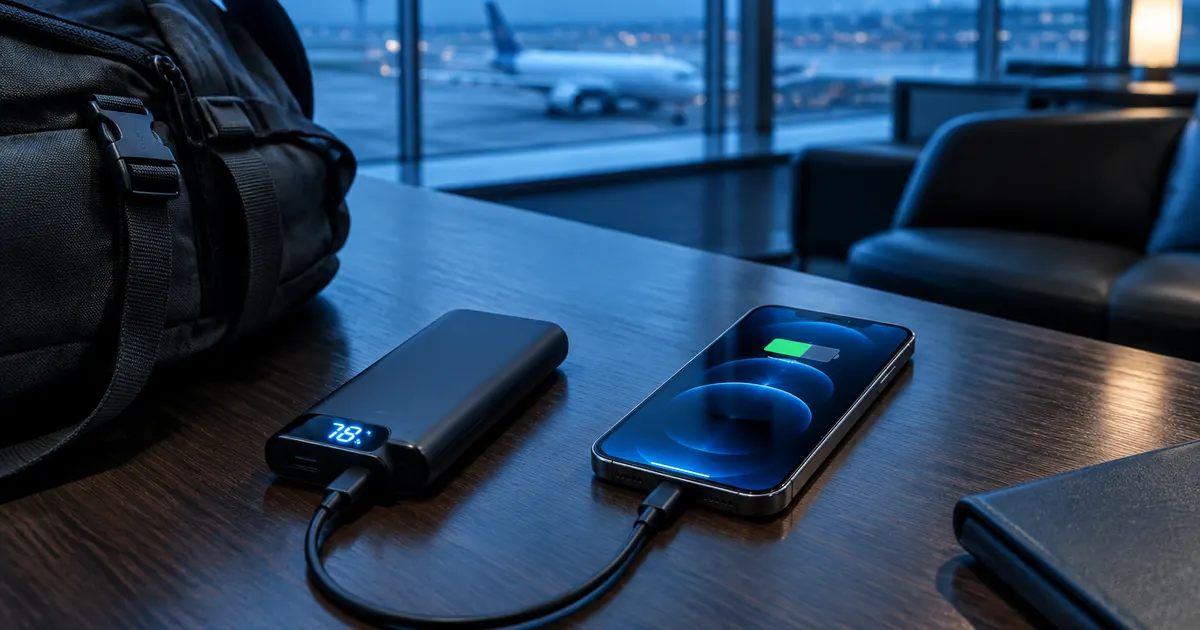
A power bank is the most lied-about product in tech. Capacity numbers are inflated, charging speeds are quoted in marketing watts the port never delivers, and the airline rules are repeated wrong. Here is the honest version — what the numbers mean, what to buy, and what security will actually allow.
mAh: The Real Math
The printed capacity is measured at the battery's internal voltage (3.7V); your device charges at 5V or higher, and conversion loses roughly 25–35% along the way. The honest rule of thumb: usable charges ≈ printed mAh × 0.65 ÷ phone battery mAh. A 20,000mAh unit against a 4,500mAh phone battery works out to about 2.9 real charges — not the five the box implies. A 20,000mAh power bank with a digital display is the sweet spot for travel: roughly three full phone charges, or one phone charge plus a tablet top-up, in a unit that still fits a jacket pocket.
Wattage: Match the Bank to the Device
Capacity fills the tank; wattage sets the speed. Phones charge happily from 18–20W ports. Tablets want 30W. Laptops need 45W minimum and prefer 65W — and if the bank's port does not support USB-C Power Delivery at that level, plugging in a laptop is a slow-motion mistake. Check the port labels: "USB-C PD 65W" means something; "fast charging" means nothing. The same logic applies to what you plug into the wall afterward — a bank this size recharges overnight on a standard port, or in about two hours from a 65W GaN charger.
Why the Digital Display Matters
Four LED dots tell you a bank is somewhere between empty and full. A percentage display tells you whether you can make the 6pm flight connection on 23%. It sounds like a luxury until the first time you are rationing battery at an airport gate — then it is the feature. Displays also expose aging: a bank that drops from 80% to 40% under one phone charge is telling you its cells are done, years before it dies completely.
The Airline Rules (Correct Version)
- Carry-on only, always. Power banks are banned from checked luggage on every major airline — lithium cells must be in the cabin where a fire would be seen.
- The 100Wh line. Most airlines allow banks up to 100Wh without approval. Watt-hours = mAh × 3.7 ÷ 1000, so a 20,000mAh bank is 74Wh — comfortably legal, printed right on the spec sheet.
- Two-bank limit. Between 100Wh and 160Wh usually requires airline approval, with a maximum of two spares. Above 160Wh is not flying.
Buy a bank with the Wh rating printed on the case — security agents look for it, and a legible label turns a random inspection into a ten-second nod.
Care: Why Banks Die Young
Lithium cells hate two things: full charge at high temperature, and deep discharge for months. The habits that double a bank's life: store it around half charge, not full; keep it out of a hot car; and top it up every couple of months rather than letting it sit at zero in a drawer. A quality bank with protection circuits handles occasional abuse — but the calendar kills more power banks than use does.
The Quick Buying Checklist
- Capacity: 10,000mAh for a pocket (about 1.5 phone charges), 20,000mAh for travel (about 3).
- Output: USB-C PD at 20W minimum, 45W+ if a laptop is ever in the picture.
- Display: percentage beats dots, always.
- Legality: under 100Wh, printed on the case, carry-on only.
Match those four and the bank simply disappears into your routine — which is the point. The Chargers & Power collection keeps the travel-tested picks one free-shipping order away.
Charging the Bank Itself
Input wattage is the spec nobody reads until the night before a trip. A 20,000mAh bank holds serious energy — refilling it over an old 10W port takes 10+ hours, while a bank with 45–65W USB-C PD input refills in about two. The same 65W GaN charger that runs your laptop refills the bank at full speed, which is the whole point of building a one-charger kit. If the bank's input spec is missing from the listing, assume slow — and plan the night before accordingly.
Multi-Device Scenarios
Real travel means the bank serves several devices at once. The honest hierarchy: the phone in navigation use draws 8–12W, a tablet 15–25W, a laptop 45–65W — and a bank outputting 65W total across two ports must split that intelligently. Quality units list their split (65W single / 45W+20W dual); the digital-display bank shows the draw live, so you can watch which device is drinking. Pass-through charging (bank charges devices while charging itself) is convenient for nightstands and hard on cells — use it occasionally, not as a permanent wiring scheme.
Matching the Bank to the Trip
A day trip needs nothing — a phone lasts the day. The real use cases: a long travel day (one top-up, 10,000mAh pocket unit), a two-day festival or flight-haul (20,000mAh), and a work trip where the laptop must survive a dead-battery presentation (65W output, 20,000mAh minimum). Buying for the worst case you actually face — not the worst case imaginable — keeps the pocket weight honest. The Chargers & Power collection sorts by exactly these scenarios.
Ready to upgrade your setup?
Every piece mentioned ships free in the USA — and it's tax free.
Shop Chargers & Power Shop Stands & Mounts