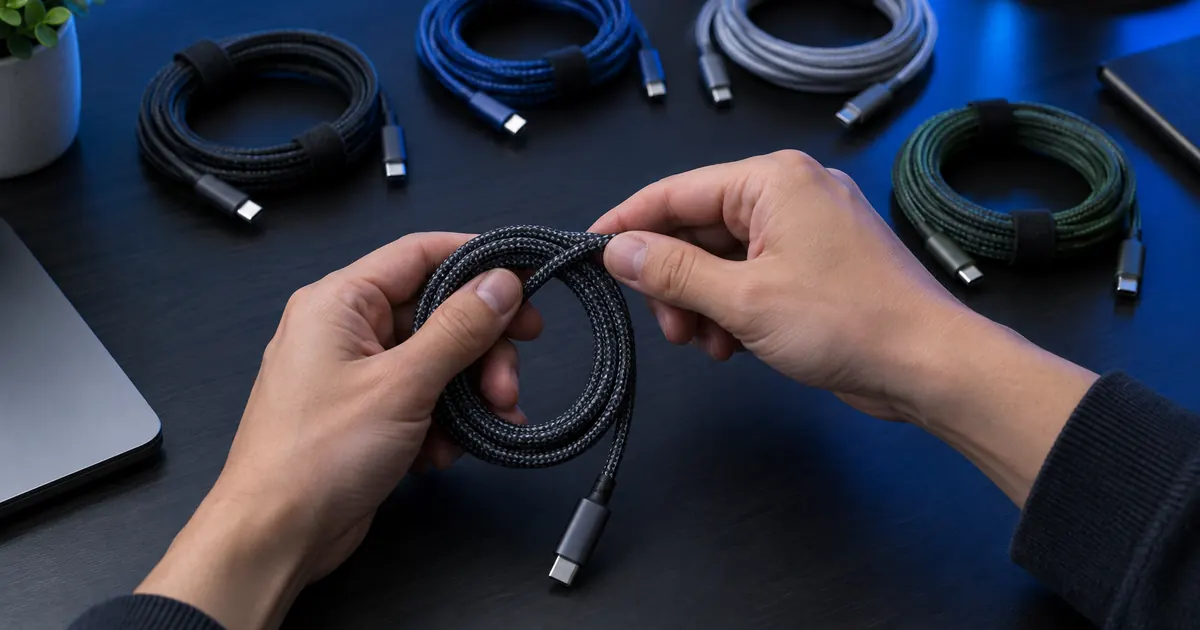
The average household buys replacement charging cables not because cables are bad, but because cables are treated badly — wrapped tight around plugs, bent at the connector, crushed under nightstand wheels. A $14 cable that lasts five years is cheaper than five $5 cables that last one. Here is the care routine that gets you there.
The Over-Under Coil (Two Minutes to Learn)
The single biggest cable killer is the tight wrist-wrap: it twists the internal conductors a quarter-turn every loop, and after a hundred wraps the copper fatigues. The over-under technique alternates loop direction — one loop over, one loop under — so twists cancel out. Coil a cable this way ten times and you will feel it: the coil lies flat, no kinks, no memory curls fighting you. This is how stage crews coil cables that survive decades of tours. It works identically for a 2-meter braided USB-C cable or the one in your car.
The 90-Degree Bend Rule
Cables fail at the connector, always — that is where the copper meets the movement. Protect the joint by never bending the cable tighter than a thumb's width right behind the plug. The practical habits: give the cable a gentle slack loop before the connector when plugging in at a wall; never yank by the cord (pull the plug); and route cables so they are not pinched between mattress and wall or desk and baseboard. Every LinkForge cable has reinforced strain relief at the connector — but relief is a last line of defense, not a license.
Braided vs. Plastic: The Honest Comparison
PVC-jacketed cables are cheaper and fine for a drawer spare. Braided nylon jackets are the better daily-carry choice for three measurable reasons: they resist the cuts and kinks that kill PVC, they slide across surfaces without sticking, and they do not stiffen and crack in cold cars. The trade is a slightly rougher feel and a fraction more weight. For anything that lives in a bag or crosses a desk daily, braided pays for itself the first year.
Storage That Doesn't Kill
Three storage rules cover every cable you own. First, loose coils — a loop the size of your forearm, secured with a velcro tie, never a knot and never wrapped around the charger brick. Second, one pouch per kit: a travel pouch with the charger and two cables means nothing lives at the bottom of a backpack getting crushed. Third, the car gets its own dedicated cable that never leaves the cupholder organizer — car cables fail from door-edge pinching more than any other cause.
When to Retire a Cable
Retire cables on evidence, not aesthetics. Warning signs: the connector wiggles in the port and charging cuts when moved; visible copper or braid wear near a plug; the device reports "accessory not supported"; or the cable only charges at one specific angle. A failing cable is not just an annoyance — intermittent connections generate heat at the connector. Retire it to the drawer-of-spares-that-work-sometimes, and put a fresh braided replacement in service.
The Five-Minute Annual Reset
Once a year: pull every cable in the house, test each on a real device, coil the keepers over-under with velcro ties, and donate the orphans. Ten minutes, and the junk drawer of mystery cables becomes a shelf of working ones. Your future self — packing at 6am for a flight — will find the working Cat 7 ethernet cable exactly where the system says it lives.
Data Cables vs. Charge Cables
Not all USB-C cables are equal on the inside, and the difference matters more than the jacket. Charge-only cables lack the data lines — they will fill a battery but refuse file transfer, CarPlay, and hub duty. If a cable "randomly" fails Android Auto or will not connect the hub, check whether it was ever a data cable at all. Keep one known-good data cable (the 2m braided USB-C carries both 100W and USB 2 data) in the travel kit and label it — the masking-tape flag looks silly and saves the third hotel-room diagnosis.
Travel Kit Architecture
The packing system that ends cable chaos: one pouch, three cables, one charger. A short 1-meter Lightning-to-USB-C for the phone, the 2-meter USB-C for the laptop and hotel-bed reach, and the braided ethernet for conference-wired reliability if the trip is work-critical. Everything coils over-under with velcro ties into a single pouch that moves from backpack to suitcase as one object. The pouch rule sounds fussy until the first time you watch someone excavate a bag for a cable at an airport gate.
The Environmental Ledger
E-waste math makes cable care a quiet environmental act: hundreds of millions of charging cables are discarded yearly, most with intact electronics and failed jackets or connectors. Every cable that survives five years instead of one is three fewer in the drawer and the landfill. Buy braided, coil it properly, retire it honestly — and when a cable does retire, electronics recycling takes them (the copper is genuinely recovered), not the household trash.
Ready to upgrade your setup?
Every piece mentioned ships free in the USA — and it's tax free.
Shop Chargers & Power Shop Stands & Mounts