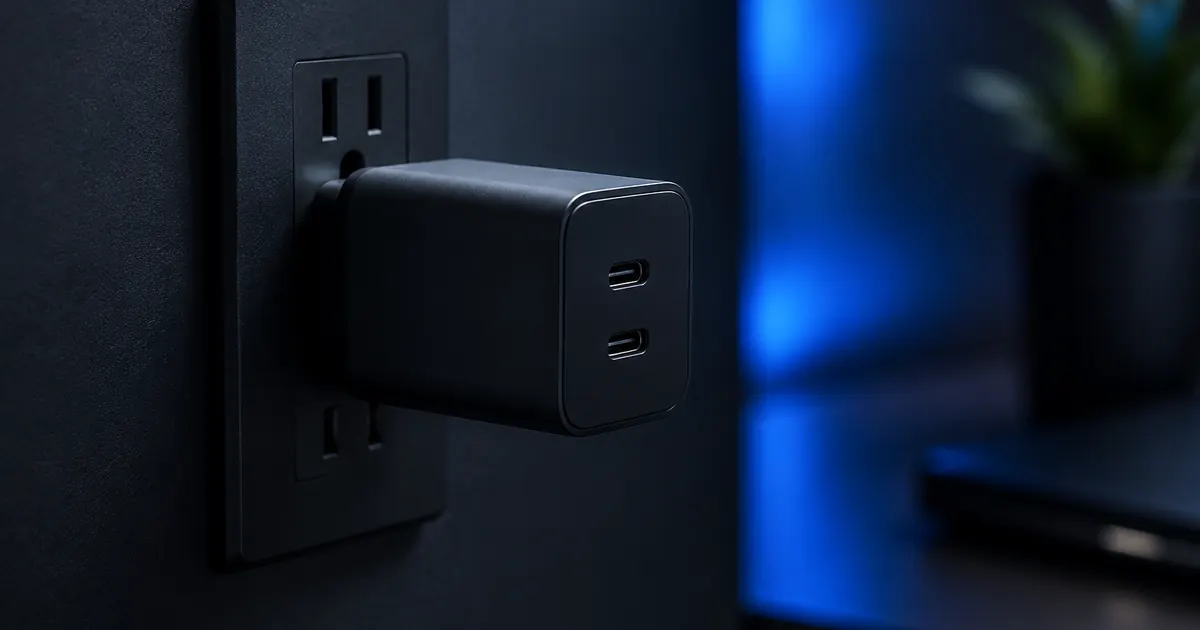
Look at the charger that came with your laptop, then look at a modern GaN brick that does the same job: the difference is not marketing, it is materials science. Gallium nitride — GaN — conducts electrons more efficiently than the silicon used in traditional chargers, which means less energy lost as heat, and less heat means smaller components can do the same work. The result is a charger that is typically 30–50% smaller, runs cooler, and wastes less power.
Wattage: What You Actually Need
Charger wattage is a ceiling, not a command — devices draw what they need. That makes choosing simple:
- Phones and earbuds: 15–30W is plenty; anything more changes nothing.
- Tablets and handhelds: 30–45W covers them comfortably.
- Laptops: 45W for most ultrabooks, 65W for 14–16-inch machines and full-speed charging under load.
A dual-port 65W GaN wall charger is the sweet spot for most people: full speed to a laptop on one port while a phone tops up on the other, in a brick smaller than the one that shipped with your laptop. Power splits intelligently when both ports are busy — the charger negotiates with each device through USB-C Power Delivery.
How Power Delivery Negotiates
USB-C Power Delivery is a conversation: the device announces what it can take, the charger offers what it can give, and they agree in milliseconds. This is why a GaN charger is safe across your whole kit — the earbuds never see 65 watts, and the laptop never accepts less than it asks for. It is also why cheap no-name chargers misbehave: the negotiation is where quality shows. Look for over-current, over-voltage, and thermal protection as listed features, not afterthoughts.
The Travel Math
Here is the kit consolidation that actually happens with one good GaN charger. Before: a laptop brick, a phone cube, a watch puck's USB plug, and a power strip's worth of fighting at the hotel nightstand. After: one dual-port 65W charger plus two short braided cables. If you carry a watch and earbuds too, a foldable 3-in-1 wireless station replaces the cable spaghetti entirely — it packs flat and charges all three from a single wall socket.
Heat: The Silent Spec
Chargers die of heat, not hours. GaN's efficiency advantage shows up exactly here: less energy becomes waste heat, so components stay cooler and age slower. In practice, a quality GaN brick is warm to the touch under a full laptop load, not hot. If a charger becomes uncomfortable to hold, it is working against itself — and slowly cooking its own capacitors. The aluminum-shelled and thermally-designed units in our Chargers & Power collection are chosen with this in mind.
Common Questions, Quick Answers
- Can a 65W charger hurt my phone? No — the phone draws only what it accepts.
- Do I need the brand's own charger? No — certified USB-C PD chargers negotiate the same safe profiles; quality of protection circuits is what matters.
- Is GaN worth the premium? For anything above 30W, yes — the size and heat difference is felt daily, especially in a travel bag.
One charger, two ports, every device — that is the whole pitch. The Chargers & Power collection keeps it free-shipping and tax-free, which is a smaller pitch but a nice one.
Reading Charger Specs Like a Pro
Three numbers tell the whole story. First, total wattage — the ceiling across all ports combined. Second, per-port wattage when shared: a "65W dual-port" charger often delivers 65W to one port alone but 45W + 20W (or 30W + 30W) when both are busy; quality spec sheets list the breakdown. Third, the PD profiles — a charger offering 5V/9V/15V/20V steps negotiates cleanly with everything from earbuds to laptops. If a listing only says "fast" without numbers, the listing is the warning.
Multi-Device Households
The modern nightstand is a charging airport: two phones, a watch, earbuds, maybe a tablet. The clean architecture is one GaN brick per zone — a 65W dual-port for the desk where laptops live, a foldable 3-in-1 station for the nightstand trio, and a 45W car charger so the car stops being the place devices go to die. Three chargers, every device covered, zero daisy-chained power strips.
Heat, Cables, and the System View
A great charger needs a cable that can carry its promise: a 65W charger through a 60W-rated cable quietly becomes a 60W charge. Use 100W-rated braided cables (like the 2-meter braided USB-C) anywhere wattage matters, and keep an eye on connector temperature during laptop charging — warm is fine, hot is a cable problem masquerading as a charger problem. Treat charger, cables, and power bank as one system and the whole kit lasts longer.
Ready to upgrade your setup?
Every piece mentioned ships free in the USA — and it's tax free.
Shop Chargers & Power Shop Stands & Mounts