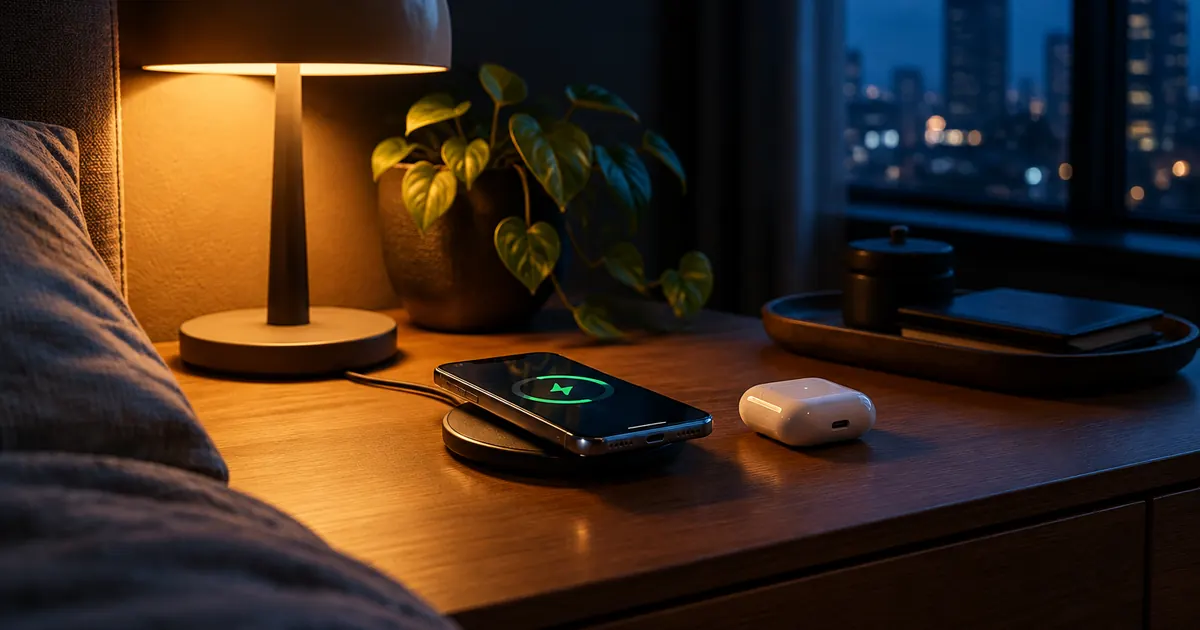
Wireless charging is the most misunderstood convenience in tech — blamed for slow speeds that are actually alignment problems, and praised for speeds that never materialize. Here is what is actually happening when your phone hovers over a pad, and how to set up charging you never think about.
How It Works, Minus the Physics Degree
The pad's coil creates a magnetic field that pulses at a frequency the phone's coil converts back into electricity. Efficiency depends on coil alignment: perfectly centered, a quality pad transfers most of its energy; a thumb off-center, and the gap leaks it as heat. This is why magnetic alignment changed everything — a magnetic 15W pad snaps the phone into the exact sweet spot every time, which is why it charges faster than a "30W" pad the phone rests crookedly on.
What the Wattage Numbers Really Mean
Wireless charging loses more energy than wired — physics taxes the air gap. Real-world expectations: 7.5W pads charge an iPhone about as fast as an old wall cube; 15W magnetic pads are meaningfully faster, filling most phones in roughly two hours; and anything advertised above 15W for iPhones hits the same ceiling because the phone caps wireless input. Android flagships vary — some accept 15W+ genuinely. The practical rule: 15W magnetic is the sweet spot; beyond that you are buying numbers, not minutes.
The Nightstand Setup That Ends Fumbling
The best wireless setup is boring by design: one pad in the same spot every night, phone snaps on without looking, morning shows 100%. The details that make it stick: the pad needs enough weight not to slide when the phone tugs free; a fabric or matte finish looks intentional on a nightstand rather than gadget-y; and the cable to the outlet should be long enough that the pad sits where your hand naturally lands — not where the furniture allows. If you share the nightstand with a watch and earbuds, a foldable 3-in-1 station charges all three in the footprint of a coffee cup, and folds into a travel case that is smaller than the book you are not reading on trips.
Heat: The Honest Trade-Off
Wireless charging runs warmer than wired — the air gap wastes energy as heat. Quality pads manage it with temperature sensors and foreign-object detection; the phone may charge in small bursts as it cools, which is normal and protective. Two habits minimize heat: charge on a hard surface rather than under a pillow (never under a pillow at all), and remove metal-heavy accessories — a steel plate from a non-magnetic car mount between pad and phone is the classic "why is it beeping" mystery.
Travel: The Foldable Question
Hotel nightstands are where wireless setups earn their keep or fail. A foldable station packs flat, sets up in seconds, and needs one outlet instead of three — pair it with a single 65W GaN charger and your entire charging kit is two objects. For shorter trips, the magnetic pad alone weighs less than the cables it replaces.
The Setup Checklist
- Nightstand: magnetic 15W pad, weighted base, cable routed behind the table.
- Desk: pad beside the monitor for top-ups between meetings — on a weighted stand if you video-call from the phone.
- Travel: foldable 3-in-1 plus one GaN brick, done.
Set it once, and charging becomes the thing you never think about — which is exactly what a nightstand is for. The full range lives in Chargers & Power, free-shipping and tax-free.
Wireless vs. Wired: When Each Wins
Wireless wins the locations where phones dwell: nightstand, desk corner, kitchen counter — anywhere the phone sits more than it is held. Wired wins everywhere speed and movement matter: gaming, navigation in the car, the 20% top-up before leaving. The mature setup is both: a magnetic pad where the phone lives, and a braided cable where it works. Fighting over which single method "wins" misses that they solve different moments — the nightstand wants convenience, the car wants watts.
Case Compatibility
Wireless charging works through most cases up to about 3mm thick — which covers every case in our Phone Cases collection, including the rugged armor. The failures are specific: cases with metal plates (for non-magnetic car mounts), credit cards stored between phone and case, and thick pop-socket rings across the coil. Magnetic cases with the built-in ring actually improve wireless charging — the pad aligns to the ring instead of hunting for the coil.
The Desk Charging Habit
Top-up charging is wireless charging's quiet superpower: 15 minutes on the pad between meetings is worth more than the theoretical speed difference versus wired, because it happens. Put a pad within arm's reach of the monitor — beside the weighted phone stand if you video-call — and the phone rides between 40% and 90% all day without a single conscious decision. Battery researchers call this range the comfort zone; the rest of us call it never thinking about charge again.
Ready to upgrade your setup?
Every piece mentioned ships free in the USA — and it's tax free.
Shop Chargers & Power Shop Stands & Mounts